petermaize

Life IS a dress rehearsal

Archive for the month “August, 2012”

Philistines and Pharisees, Pt. 2: Acceptable Crimes

Staunch opponents of abortion often declare that abortion is murder. They believe that life begins at conception, and therefore terminating a pregnancy at any point amounts to taking a human life.

If indeed abortion is murder, then it follows that no pregnancy can be terminated, regardless of the circumstances, since there is no such thing as “justifiable murder.” Homicide refers to the taking of a human life, and there are many legal definitions of justifiable homicide (one will be argued in the Trayvon Martin shooting). But murder by definition is the unlawful premeditated killing of one human by another. It is never legal.

It is difficult to imagine the anguish of a rape victim who is asked to give birth to her assailant’s child. But if abortion is indeed murder, then the crime of rape does not excuse the crime of murder, and the birth must take place.

Most Americans agree that abortions should be legal for rape and incest victims. A recent survey indicated that only 22% of Amercians would ban abortions in those cases. The Republican Party has taken the position in their party platform that all abortions should be outlawed in all cases.

Most anti-abortion candidates for high office would allow abortions under certain circumstances. This is bad logic, but good politics. Politicians must appeal to a diverse electorate. Advocating the strictest interpretation of abortion means alienating a large percentage of voters. However, if you oppose abortion in some cases but not all, then abortion is merely homicide–and in some cases, it is justifiable homicide. Suddenly the moral imperative to ban abortion disappears. When the cause of the pregnancy is deemed too abhorent, then abortion is okay. This is moral relativism. It is the position of the Pharisees.

The Philistines have their own viewpoint on abortion, and it is no more intellectually stable than the Pharisees’. They argue that life does not begin at conception, but at some later point during the pregnancy. If you kill a baby moments after it is born, that is murder most horrible. And probably two months before birth is also reprehensible. But maybe five months is okay. No crime. No guilt. They don’t want to deal with the clear fact that once conception begins, a human being will surely result unless action is taken to prevent it. Devising arbitrary concepts of “when a person becomes a person” is semantics, not ethics.

Christians are not called to be moral relativists. Successful politicians must be. Christians don’t believe that “the end justifies the means”, but that is part of politics. Now, of course there are many Christian politicians: most people in Congress would identify themselves as Christians. But for the most part they end up acting like Pharisees, because they want to legislate human behavior without applying the teachings of Christ. “Do not resist an evil man…turn the other cheek” isn’t good national defense. More importantly, it won’t get you elected. There are plenty of clear directives from Jesus that Christians are called to follow, but they are deemed too unrealistic to actually be implemented in real life. As Captain Barbosa would say, “it’s more what you’d call ‘guidelines’ than actual rules.”

Hence, the world doesn’t change.

In 2004, when the atrocities at Abu Ghraib prison in Iraq became known, imagine what would have happened if America’s evangelical leaders had called a news conference to announce publicly and clearly that “Christians don’t torture.” The world would have taken notice, non-Christians would have gained a new appreciation of the faith and a moral tone would have been set for the nation.

But moral relativism means that often we behave in ways that serve our larger goals, or protect our interests (personal or national). Our prejudices and preferences also get in the way. American Christians promote firearms in ways that no other Christian society does. Our love of guns is obviously anithetical to the teachings of Christ. But if religion is merely rules, then we can still be good Christians if we follow the rules we create for ourselves–and impose on others.

Pharisees are all about rules. Philistines are all about uninhibted pursuit of selfish desires.

Jesus is all about love, compassion and sacrifice. Sacrifice! For strangers and enemies! Not too appealing to either Philistines or Pharisees. So instead they debate an issue like abortion where politics and situation ethics determine their positions, and both sides feel content that they are either protecting human rights or following God’s law. In the meantime, the Philistines ignore the fact that for most people this is an exercise in selfishness: they just want to have sex without consequences. And the Pharisees prefer to issue laws that dictate and control behavior, as if that ever worked in the past. As if laws can change the human heart.

Most people have heard of the Bible story that contains the line “Let whoever is without sin cast the first stone.”

That’s a tricky Bible story–so tricky that it’s not even included in many early versions of the New Testament. But it highlights the key distinction between the ways of the Pharisees and the way that Christians are called to act toward others. In the story, a woman has been caught in adultery. The Pharisees bring her to Jesus, which seems odd, since they would normally just judge and sentence her–to death by stoning. But the Bible says they bring the woman to Jesus “to test him, that they might have some charge against him.” They  knew that this Jesus fellow was likely to act in non-traditional ways. The hardliners wanted to show that Jesus wasn’t following the Law.

You know how the story goes. When Jesus confronted the Pharisees, they drifted away one by one, until just Jesus and the woman were left standing alone. He told her that he did not condemn her, but admonished her to “go, and sin no more.”

It’s much easier to judge people than to love them. It’s easier to engage in culture wars with Philistines, claiming they are destroying our Christian nation. But attraction works better than promotion. The way to change society is not by tacking the Ten Commandments on the courthouse wall. The best way is to lead by example, to live a life that demonstrates God’s love. The Philistines are looking for something, and think they can find it by following the selfish desires of their hearts. They look at the Pharisees, who appear to be mean-spirited hypocrites, and the Philistines reject the only answer that will truly satisfy them: a selfless love that doesn’t judge others, but merely seeks to act as Jesus has clearly taught us to act.

In the meantime, Christian politicians refuse to denounce torture, allow widespread distribution of automatic weapons, modify their positions on abortion and tell people what they want to hear. Literally following the teachings of Jesus is just too doggone dangerous. And it won’t get you elected.

“The scribes and the Pharisees sit on Moses’s seat, so practice and observe whatever they tell you–but not what they do. For they preach, but do not practice. They tie up heavy burdens, hard to bear, and lay them on peoples’ shoulders, but they themselves are not willing to move them with their finger.”

“But woe to you, scribes and Pharisees, hypocrites! For you shut the kindom of heaven in people’s faces. For you neither enter yourselves nor allow those who would enter to go in.”

From the Gospel of Matthew, chapter 23.
 

Who’s Your Favorite Poet?

Very few people buy books of poetry anymore.

In our age, poetry is something you’re required to read in sophomore English class, or perhaps you attempt a few verses yourself as an angst-filled teenager. After that, poetry ceases to exist. Maybe you pause to read a poem in The New Yorker as you flip through the pages, if it’s not too long. But seriously, when was the last time you read a poem?

Since the 60’s we’ve been getting our poetry from Dylan and U2 and Jay-Z. Or at least that’s what we tell ourselves.

“I have measured out my life with coffee spoons.” That’s from The Love Song of J. Alfred Prufrock–perhaps one of those poems you had to read in sophomore poetry class. It’s a glimpse into the insecurities and impotence of a man who resigns himself to loneliness rather than risk rejection. Although much of the poem is hard to decipher, the imagery of a life measured out with tiny coffee spoons is crystal clear.

Poets use imagery in ways that rappers, rockers and divas cannot. Poets are not bound by 4/4 melodies and choruses. They make up their own meter, as T.S. Eliot did in Prufrock.

Eliot said “the progress of an artist is a continual self-sacrifice, a continual extinction of personality.” That’s definitely not how today’s artists operate. Self-promotion and image have replaced the introspection of the poets. Great literature makes true statements about the human condition; timeless observations on what it means to live and struggle and learn.

Where are the poets today who can share these lessons and reveal the truth? And who is listening?


Dr Li.

Dr Li.

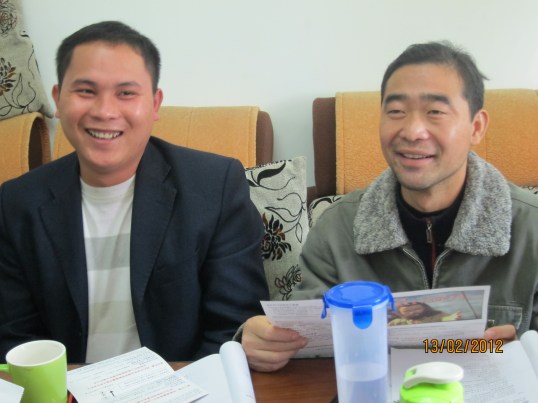
Yesterday I wrote about Dr. Li. Here he is, on the right

Nine Dragons Belly UP sneak preview

Here’s a selection from Nine Dragons Belly Up, the sequel to Zoom Out.

Nine Dragons take place at the height of the Dotcom frenzy of 1999.

It’s set in Hong Kong and follows the characters from Zoom Out in their new roles as employees of Asia’s hottest Internet company, Nine Dragons.

ONE DAY AT A TIME

I went to an AA meeting during lunch, to clear my head. I was fascinated by the things Clive was saying, but apprehensive about whether I was the kind of guy he was looking for. And I was certain there is no way I could survive at Nine Dragons unless I stopped drinking.

I’m not sure if Alcoholics Anonymous is the answer for me, but at least it’s kept me sober for nine days. I know that doesn’t sound like a lot, but it’s close to a record for me. Anyhow, things (my emotions, my finances, my life) have been pretty ragged recently, and the meetings provide a kind of anchor, a little stability as I try to do this “one day at a time” thing.

One day at a time. Like I’m really going to convince myself that it’s only these bite-size twenty-four-hour chunks—as if I’m not looking at utter, bone-dry, boring sobriety for the rest of my life. Like I can fool myself.

The AA meetings take place in a big, rundown, former Victorian mental hospital. That seems appropriate. It’s actually kind of a cool room. The ceiling is at least thirty feet high, and there are creaky ceiling fans hanging down, wisps of cobwebs draped from them. Tall windows with big metal bolts line the walls, and a disused fireplace adds a touch of faded elegance. It’s a comfortable place. A designated area for alcoholics to sit around reminiscing about the bad old days or how grateful they are or what step they’re on.

The people in the room don’t look like alcoholics. Most are in their thirties or forties. Men wearing ties, on their lunch breaks. Only three women. An old British woman, an American housewife type, and an intriguing girl I haven’t seen before. She appears to be in her twenties. Attractive in an ethereal way, with very long brown hair almost down to her waist. I really like long hair. I watch her surreptitiously because I don’t want to be caught scoping out chicks in an AA meeting. That would he too sad for words. So I glance over discreetly from time to time.

The girl listens as people talk, watching them passively. Sometimes she stares down at the coffee mug in her hand, as if she is thinking about something. I look away before she sees me.

“I’m just so grateful.”

A mousy American woman is talking about her relationship with her Higher Power. God help me. She goes on and on about how her life has changed, how she likes herself now.

That’s great, honey.

“And that’s all I have to share. I’m just glad you all are here. Thanks for keeping me sober.” The mousy woman is finished “sharing”.

“Thanks Martha,” everyone says in unison. This always sounds so stupid to me. Whenever anyone shares, they always start off with, “Hi, my name’s_________, and I’m an alcoholic.” Everyone says “Hi, ________” in unison. Then the person rambles on for a while. Sometimes it’s pretty interesting. If nothing else, there are a lot of good stories in AA. I’ve already heard myriad tales of drunken debauches, crashed cars and suicide attempts. There’s an Australian guy named Dollar Bill. Looks about sixty, with lots of old-style tattoos (women in bikinis, anchors, that sort of thing). He flies cargo planes across the South Pacific. Apparently he was in Vietnam and flew lots of contraband around Southeast Asia before he got sober.

Bill was the last person to “share” at the meeting, and he told us about waking up “on the floor—again—not knowing where I was, and not even knowing who I was. Can you imagine that? I came to, and the room was empty, and I was covered in blood. Didn’t know whose blood it was, either. So I lay there on the floor, feeling dreadful and filled with dread. Eventually remembered who I was, but it wasn’t until I got up and walked out of the room that I could even recognize which country I was in. Thailand. I could tell by the sounds aand smells. How had I gotten there? No idea. Whose blood was it?”

Bill glanced slowly around the room, one of his eyes large and the other squeezed almost shut.

“Checked myself thoroughly, and couldn’t find a scratch. So it wasn’t my blood. Never found out whose it was. Police never came for me. My wallet was still in my back pocket, so I crept down the stairs. Didn’t run across anyone until I hit the street. I was in one of the small cities down south—Hat Yai, I think. Looked to my right and saw a bar. Knew I could use a Bloody Mary, so I stumbled on in and ordered one. Bartender looked at me a bit queer but didn’t say a word. Found a plane out the next day and returned to Melbourne like nothing had happened.”

He shook his head.

“Denial. It’s not the name of a river in Egypt.” Everyone said “Thanks, Bill.”

The meeting wrapped up the way it always does. We held hands, which I’m not too keen about. Then we recited the Serenity Prayer, which I still can’t remember. Then people milled around, talking or smoking on the verandah. I joined the smokers. The ethereal girl with long hair sauntered straight toward me.

“Can I have a cigarette?” she asked in a husky voice. She is really good looking, sexy in an unconventional way. Wore baggy clothes and no makeup as far as I could tell. I gave her a MaMarlboro and lit it for her.

“Thanks,” she said, and strolled off to lean against one of the big pillars. I realized she hadn’t looked at me. I looked at her a lot during the meeting, wondering what her story is, and whether she has a boyfriend. I’d like to get to know the ethereal girl. I don’t even know her name. I’ve never heard her speak in a meeting before. Good God, what if we ended up dating? I’d be a guy who met his girlfriend in Alcoholics Anonymous. Oh God, just shoot me.

Hi, I’m Brian, and I’m an alcoholic.

THE INTERNET WILL CHANGE EVERYTHING

When I got back after lunch I’d already received the email from Amy. There were five topics, or threads, as they are termed, with three people assigned to each topic. Here is my group’s task:

Create content based on these two categories:

a) MP3

b) Agriculture

Agriculture?

We must design a format that allows a person, anywhere in the world, to interact with our segments through TV, the Web, over mobile phones or maybe even by carrier pigeon—I’m not sure. For example, we might have a band playing live on TV, which will be broadcast all around the world. People could watch them play live, and chat with other viewers via the Internet, or email Nine Dragons and rate the band or call on their mobile phones and request a different song. People who have cameras attached to their computers could actually talk to the band and appear on TV. Then maybe other people could upload pictures they had drawn of the band members and send them to Nine Dragons, and we would put those pictures up instantly, while the band was still playing. Or maybe other people would send in their own songs, and everyone would rate those songs. Staff back at Nine Dragons would be monitoring all the input, and switching back and forth to whatever seemed to be the coolest stuff at any given moment.

Phew.

I decided to take a cigarette break and headed up to the roof of our twenty-four story building. I get my most valuable information about Nine Dragons up on the roof, talking with fellow smokers. Amy Spencer smokes a lot, so almost every time I traipse up the stairs to the roof, she’s there. We’ve established a pretty good relationship, even though she’s senior to me and knows I don’t really know anything about broadcasting or the Internet. Perhaps that’s the reason we get along. I’m not a rival. Just a fellow smoker.

Amy was gazing out over the harbor sucking on a Salem Light when I came up.

“Planning another day of world conquest?” I joked.

Amy smiled in a world-weary journalist sort of way.

“Something like that.”

I lit up and looked across at Kowloon, from whence our company gets its name. Kowloon is an Anglicized rendering of gau lung: nine dragons.

“You know,” Amy said, “our deadline is impossible to meet.”

“Is it?” I a ssumed she was referring to Clive’s mandate that our service be launched by December 31st, less than four months away.

“Yep. There are no two ways about it. We don’t have enough time to recruit sufficient staff, build the facilities, develop programming and ramp up production. It is absolutely impossible.”

“Do Clive and Guy know this?”

Amy shook her head sadly. “I’ve talked to Guy, but he just smiles enigmatically and says we’ll make it. Of course I can’t say anything to Clive, because I’m not senior enough and he would take my comments as a lack of faith; an indication that I wasn’t a true believer.”

Amy really seemed distraught by this. I have no way of knowing whether our schedule is realistic. But Amy worked at the local cable TV company when they rolled out their service a few years ago. She ran their English news department, and apparently had to do similar things on a smaller level: hire people, build a control room, and so on. So maybe she knows what she’s talking about.

“Well, I’m doing my best to create a really solid agriculture thread,” I said, hoping to make her laugh.

Amy looked at me reproachfully, as a mother would toward an obnoxious child.

“I’m sure you are, Brian. But we don’t have any of the back-end designed yet, don’t have the facilities built yet, don’t have the people hired and trained and ready to do a combined TV and Web service twenty-four hours a day.”

I could tell she was about to take out another cigarette, but she thought better of it.

“And we’ve got a leader who is wanted on felony charges in Europe.”

I exhaled slowly, then said the obligatory, “What?”

Amy turned to look out over the harbor again, as it shimmered with boats and sunlight.

“Clive Walker got himself involved in a few scams in the former Soviet satellite countries right after the break-up of the U.S.S.R. It gets complicated, but it involves fraud, theft on a grand scale and maybe murder.”

She turned back to look at me.

“How do you know this?” I asked.

Amy decided to have that second cigarette.

“I’m a journalist, Brian. That’s my background. When I got this amazing job I wanted to know everything I could about the people who were running it. I called a former colleague who works at the Sydney Herald now. He remembered the name, and after a couple of weeks I was able to dig up old news reports from ’91 that revealed that our boss was convicted in absentia in Belarus, after he’d fled the country. He can’t go anywhere near Europe these days, but he’s safe from extradition out here.”

Amy took a long pull, held the smoke in and exhaled slowly, the way real nicotine aficionados do.

“Clive always protested his innocence. Said he was set up by the local mafia. I don’t know. But I do know that he’s a con artist who is used to dealing in huge amounts of money. And when I see Nine Dragons receive millions and millions of dollars to do something that’s never been done before, with people who’ve never done anything like this before on an impossible time schedule . . . well, it makes me wonder.”

She tossed her still-burning cigarette on the tiled roof.

“Make of that what you will, Brian. In the meantime, I’ll continue to do my job—just in case this outrageous scheme is going to work.”

The Greatest Thing I’ve Ever Done

A few years ago I was producing a TV program in China called Moving Mountains.

It was a great job. We would travel all over the country shooting stories on people who were performing amazing acts of kindness and compassion. China is full of these stories.

Despite the perception (shared by the Chinese public) that most Chinese are primarily intent on getting rich and pursuing selfish goals, there are many stories of selfless sacrifice and astonishing generosity. We did one story on a man who adopted 200 children. Another followed a man in the mountains of central China as he carried an old, hand-cranked film projector and spools of film to the most remote villages imaginable. He just thought these people should have a chance to watch movies, too. So he devoted his life to bringing the movies to them. For free.

There were many other stories: some impressive in their scope, others very simple, like the one where three schoolboys vowed to carry a crippled schoolmate to school every day on their backs. At lunchtime they would carry him out to the playground and after school carry him home.

Then we found the story of Dr. Li. Dr. Li was a country doctor in a very poor part of southern China.

He was the only physician within a day’s travel, and people would come to his clinic with all kinds of medical problems–but seldom with enough money to pay for their treatment. Dr. Li never refused to treat anyone, and would give them medicine even if they couldn’t afford it. He paid for the medicine himself.

One day Dr. Li learned that he had kidney disease. The cost of the kidney medicine and dialysis were very expensive, and Dr. Li had no money, because he had used all of his own savings to help his patients. He borrowed from relatives, but eventually saw that he was only driving his family into debt, and decided that he would no longer treat his kidney disease. Dr. Li prepared himself for death.

It was at this time that our TV crew found him. We’d heard about the selfless, compassionate doctor in Guangxi province, so we’d arranged to come shoot his story. But we didn’t know that he was seriously ill. Dr. Li only told the crew about his situation reluctantly, as they were about to leave.

He had 2 weeks of medicine left. After that, he would purchase no more.

The crew called me and told me the situation. I told them to give whatever expense money they had left to Dr. Li, so at least he could buy a little more medicine. But we realized that what he needed was a kidney transplant, which cost about US$30,000 ($240,000 Hong Kong dollars). That was an insurmountable number. It might as well have been $30 million. But I felt clearly that we should do something to help Dr. Li. We took a collection among the staff here at the CBN Hong Kong office. That got us about HK$1,000. Then we told viewers of our Hong Kong TV program about Dr. Li’s situation, and mentioned that our staff had put together a little bit of money to help him. We told the audience that if they also wanted to help him, they could send money to our office in Hong Kong.

By the time donations reached HK$900,000, we had to tell people to stop giving.

The outpouring of support enabled Dr. Li to go to Beijing and have his surgery. The night before the operation he made a decision to become a Christian. You might be thinking: “sure, why not? A little insurance just in case something goes wrong.”

After he recovered, Dr. Li returned to his village and continued to help people just as he had always done. The big difference was, now he didn’t have to use his own money.

There was still about HK$400,000 (US$50,000) left. Some of that money was earmarked to pay for the anti-rejection medicine that Dr. Li would take for a long time, and to pay for his ongoing medical bills. But there was money left over to help cover the costs of poor villagers who continued to visit Dr. Li’s clinic. We asked the people who had donated to Dr. Li, and they all agreed that the extra money could be used this way.

He was able to buy some basic medical equipment for the first time, in order to serve the public better. He also initiated hygeine and preventive medicine programs in his region.

Dr. Li became famous in this part of China. A TV station from the provincial capital sent a crew to do a story about him and his service to the poor. They never mentioned CBN or our role in Dr. Li’s life. They also didn’t mention that he had begun holding Bible studies in his home, sharing his new faith with others and applying it in his own life. Over time many people in the region became Christians and became more involved in helping others. Churches from other provinces travel to his village to meet Dr. Li and his region has become very active in Christian service.

Last month the government asked Dr. Li if he would be willing to build a church in his village.

He said yes. The government is willing to tolerate this Christian stuff, but they want it all to be officially approved. The Chinese government is like that.

So why is this the greatest thing I’ve ever done? It’s not because I made something happen. It’s because when God spoke, I listened and trusted. I felt sure that we were called to help this anonymous country doctor, even though it would be impossible to raise enough money to assist him.

As Christians say, “God put it on my heart” to help Dr. Li. It seemed to be an impossible task, but I saw what God was able to do when we trust him and follow his guidance. I actually didn’t have to do much, except trust.

Some people will say that the greatest thing they’ve ever done is being a parent. That is an incomparable vocation. My wife and I try our best to raise our children well, and it is a joy to do so. But when it comes to a single action I have taken, a single thing that I have done, none compares to the simple decision to listen to God’s direction and follow it faithfully.

I have witnessed what happens. None of us at CBN did much in this situation, except to believe and obey.

That is the greatest thing you can do.

Post Navigation