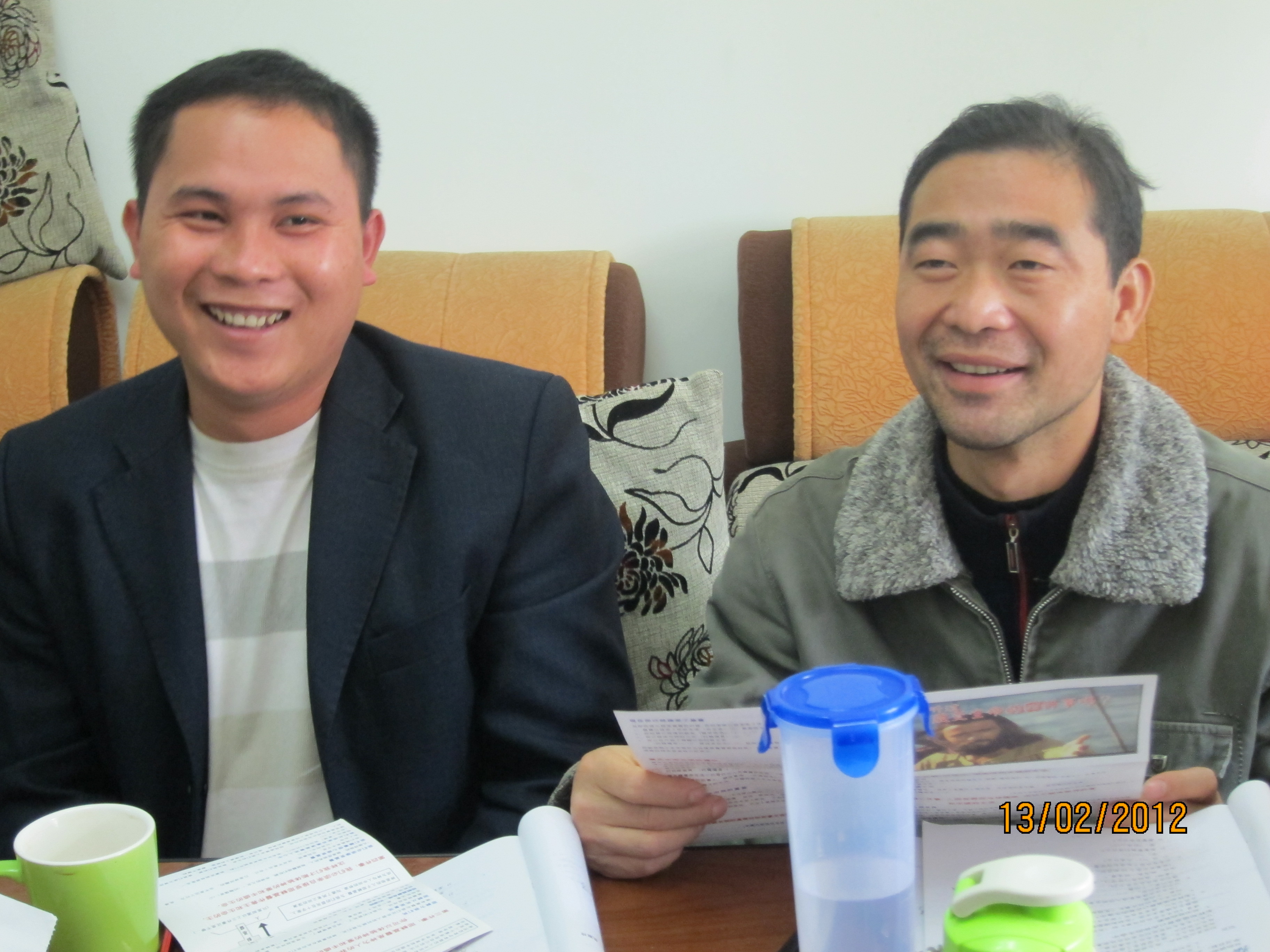
Yesterday I wrote about Dr. Li. Here he is, on the right
Here’s a selection from Nine Dragons Belly Up, the sequel to Zoom Out.
Nine Dragons take place at the height of the Dotcom frenzy of 1999.
It’s set in Hong Kong and follows the characters from Zoom Out in their new roles as employees of Asia’s hottest Internet company, Nine Dragons.
ONE DAY AT A TIME
I went to an AA meeting during lunch, to clear my head. I was fascinated by the things Clive was saying, but apprehensive about whether I was the kind of guy he was looking for. And I was certain there is no way I could survive at Nine Dragons unless I stopped drinking.
I’m not sure if Alcoholics Anonymous is the answer for me, but at least it’s kept me sober for nine days. I know that doesn’t sound like a lot, but it’s close to a record for me. Anyhow, things (my emotions, my finances, my life) have been pretty ragged recently, and the meetings provide a kind of anchor, a little stability as I try to do this “one day at a time” thing.
One day at a time. Like I’m really going to convince myself that it’s only these bite-size twenty-four-hour chunks—as if I’m not looking at utter, bone-dry, boring sobriety for the rest of my life. Like I can fool myself.
The AA meetings take place in a big, rundown, former Victorian mental hospital. That seems appropriate. It’s actually kind of a cool room. The ceiling is at least thirty feet high, and there are creaky ceiling fans hanging down, wisps of cobwebs draped from them. Tall windows with big metal bolts line the walls, and a disused fireplace adds a touch of faded elegance. It’s a comfortable place. A designated area for alcoholics to sit around reminiscing about the bad old days or how grateful they are or what step they’re on.
The people in the room don’t look like alcoholics. Most are in their thirties or forties. Men wearing ties, on their lunch breaks. Only three women. An old British woman, an American housewife type, and an intriguing girl I haven’t seen before. She appears to be in her twenties. Attractive in an ethereal way, with very long brown hair almost down to her waist. I really like long hair. I watch her surreptitiously because I don’t want to be caught scoping out chicks in an AA meeting. That would he too sad for words. So I glance over discreetly from time to time.
The girl listens as people talk, watching them passively. Sometimes she stares down at the coffee mug in her hand, as if she is thinking about something. I look away before she sees me.
“I’m just so grateful.”
A mousy American woman is talking about her relationship with her Higher Power. God help me. She goes on and on about how her life has changed, how she likes herself now.
That’s great, honey.
“And that’s all I have to share. I’m just glad you all are here. Thanks for keeping me sober.” The mousy woman is finished “sharing”.
“Thanks Martha,” everyone says in unison. This always sounds so stupid to me. Whenever anyone shares, they always start off with, “Hi, my name’s_________, and I’m an alcoholic.” Everyone says “Hi, ________” in unison. Then the person rambles on for a while. Sometimes it’s pretty interesting. If nothing else, there are a lot of good stories in AA. I’ve already heard myriad tales of drunken debauches, crashed cars and suicide attempts. There’s an Australian guy named Dollar Bill. Looks about sixty, with lots of old-style tattoos (women in bikinis, anchors, that sort of thing). He flies cargo planes across the South Pacific. Apparently he was in Vietnam and flew lots of contraband around Southeast Asia before he got sober.
Bill was the last person to “share” at the meeting, and he told us about waking up “on the floor—again—not knowing where I was, and not even knowing who I was. Can you imagine that? I came to, and the room was empty, and I was covered in blood. Didn’t know whose blood it was, either. So I lay there on the floor, feeling dreadful and filled with dread. Eventually remembered who I was, but it wasn’t until I got up and walked out of the room that I could even recognize which country I was in. Thailand. I could tell by the sounds aand smells. How had I gotten there? No idea. Whose blood was it?”
Bill glanced slowly around the room, one of his eyes large and the other squeezed almost shut.
“Checked myself thoroughly, and couldn’t find a scratch. So it wasn’t my blood. Never found out whose it was. Police never came for me. My wallet was still in my back pocket, so I crept down the stairs. Didn’t run across anyone until I hit the street. I was in one of the small cities down south—Hat Yai, I think. Looked to my right and saw a bar. Knew I could use a Bloody Mary, so I stumbled on in and ordered one. Bartender looked at me a bit queer but didn’t say a word. Found a plane out the next day and returned to Melbourne like nothing had happened.”
He shook his head.
“Denial. It’s not the name of a river in Egypt.” Everyone said “Thanks, Bill.”
The meeting wrapped up the way it always does. We held hands, which I’m not too keen about. Then we recited the Serenity Prayer, which I still can’t remember. Then people milled around, talking or smoking on the verandah. I joined the smokers. The ethereal girl with long hair sauntered straight toward me.
“Can I have a cigarette?” she asked in a husky voice. She is really good looking, sexy in an unconventional way. Wore baggy clothes and no makeup as far as I could tell. I gave her a MaMarlboro and lit it for her.
“Thanks,” she said, and strolled off to lean against one of the big pillars. I realized she hadn’t looked at me. I looked at her a lot during the meeting, wondering what her story is, and whether she has a boyfriend. I’d like to get to know the ethereal girl. I don’t even know her name. I’ve never heard her speak in a meeting before. Good God, what if we ended up dating? I’d be a guy who met his girlfriend in Alcoholics Anonymous. Oh God, just shoot me.
Hi, I’m Brian, and I’m an alcoholic.
THE INTERNET WILL CHANGE EVERYTHING
When I got back after lunch I’d already received the email from Amy. There were five topics, or threads, as they are termed, with three people assigned to each topic. Here is my group’s task:
Create content based on these two categories:
a) MP3
b) Agriculture
Agriculture?
We must design a format that allows a person, anywhere in the world, to interact with our segments through TV, the Web, over mobile phones or maybe even by carrier pigeon—I’m not sure. For example, we might have a band playing live on TV, which will be broadcast all around the world. People could watch them play live, and chat with other viewers via the Internet, or email Nine Dragons and rate the band or call on their mobile phones and request a different song. People who have cameras attached to their computers could actually talk to the band and appear on TV. Then maybe other people could upload pictures they had drawn of the band members and send them to Nine Dragons, and we would put those pictures up instantly, while the band was still playing. Or maybe other people would send in their own songs, and everyone would rate those songs. Staff back at Nine Dragons would be monitoring all the input, and switching back and forth to whatever seemed to be the coolest stuff at any given moment.
Phew.
I decided to take a cigarette break and headed up to the roof of our twenty-four story building. I get my most valuable information about Nine Dragons up on the roof, talking with fellow smokers. Amy Spencer smokes a lot, so almost every time I traipse up the stairs to the roof, she’s there. We’ve established a pretty good relationship, even though she’s senior to me and knows I don’t really know anything about broadcasting or the Internet. Perhaps that’s the reason we get along. I’m not a rival. Just a fellow smoker.
Amy was gazing out over the harbor sucking on a Salem Light when I came up.
“Planning another day of world conquest?” I joked.
Amy smiled in a world-weary journalist sort of way.
“Something like that.”
I lit up and looked across at Kowloon, from whence our company gets its name. Kowloon is an Anglicized rendering of gau lung: nine dragons.
“You know,” Amy said, “our deadline is impossible to meet.”
“Is it?” I a ssumed she was referring to Clive’s mandate that our service be launched by December 31st, less than four months away.
“Yep. There are no two ways about it. We don’t have enough time to recruit sufficient staff, build the facilities, develop programming and ramp up production. It is absolutely impossible.”
“Do Clive and Guy know this?”
Amy shook her head sadly. “I’ve talked to Guy, but he just smiles enigmatically and says we’ll make it. Of course I can’t say anything to Clive, because I’m not senior enough and he would take my comments as a lack of faith; an indication that I wasn’t a true believer.”
Amy really seemed distraught by this. I have no way of knowing whether our schedule is realistic. But Amy worked at the local cable TV company when they rolled out their service a few years ago. She ran their English news department, and apparently had to do similar things on a smaller level: hire people, build a control room, and so on. So maybe she knows what she’s talking about.
“Well, I’m doing my best to create a really solid agriculture thread,” I said, hoping to make her laugh.
Amy looked at me reproachfully, as a mother would toward an obnoxious child.
“I’m sure you are, Brian. But we don’t have any of the back-end designed yet, don’t have the facilities built yet, don’t have the people hired and trained and ready to do a combined TV and Web service twenty-four hours a day.”
I could tell she was about to take out another cigarette, but she thought better of it.
“And we’ve got a leader who is wanted on felony charges in Europe.”
I exhaled slowly, then said the obligatory, “What?”
Amy turned to look out over the harbor again, as it shimmered with boats and sunlight.
“Clive Walker got himself involved in a few scams in the former Soviet satellite countries right after the break-up of the U.S.S.R. It gets complicated, but it involves fraud, theft on a grand scale and maybe murder.”
She turned back to look at me.
“How do you know this?” I asked.
Amy decided to have that second cigarette.
“I’m a journalist, Brian. That’s my background. When I got this amazing job I wanted to know everything I could about the people who were running it. I called a former colleague who works at the Sydney Herald now. He remembered the name, and after a couple of weeks I was able to dig up old news reports from ’91 that revealed that our boss was convicted in absentia in Belarus, after he’d fled the country. He can’t go anywhere near Europe these days, but he’s safe from extradition out here.”
Amy took a long pull, held the smoke in and exhaled slowly, the way real nicotine aficionados do.
“Clive always protested his innocence. Said he was set up by the local mafia. I don’t know. But I do know that he’s a con artist who is used to dealing in huge amounts of money. And when I see Nine Dragons receive millions and millions of dollars to do something that’s never been done before, with people who’ve never done anything like this before on an impossible time schedule . . . well, it makes me wonder.”
She tossed her still-burning cigarette on the tiled roof.
“Make of that what you will, Brian. In the meantime, I’ll continue to do my job—just in case this outrageous scheme is going to work.”
A few years ago I was producing a TV program in China called Moving Mountains.
It was a great job. We would travel all over the country shooting stories on people who were performing amazing acts of kindness and compassion. China is full of these stories.
Despite the perception (shared by the Chinese public) that most Chinese are primarily intent on getting rich and pursuing selfish goals, there are many stories of selfless sacrifice and astonishing generosity. We did one story on a man who adopted 200 children. Another followed a man in the mountains of central China as he carried an old, hand-cranked film projector and spools of film to the most remote villages imaginable. He just thought these people should have a chance to watch movies, too. So he devoted his life to bringing the movies to them. For free.
There were many other stories: some impressive in their scope, others very simple, like the one where three schoolboys vowed to carry a crippled schoolmate to school every day on their backs. At lunchtime they would carry him out to the playground and after school carry him home.
Then we found the story of Dr. Li. Dr. Li was a country doctor in a very poor part of southern China.
He was the only physician within a day’s travel, and people would come to his clinic with all kinds of medical problems–but seldom with enough money to pay for their treatment. Dr. Li never refused to treat anyone, and would give them medicine even if they couldn’t afford it. He paid for the medicine himself.
One day Dr. Li learned that he had kidney disease. The cost of the kidney medicine and dialysis were very expensive, and Dr. Li had no money, because he had used all of his own savings to help his patients. He borrowed from relatives, but eventually saw that he was only driving his family into debt, and decided that he would no longer treat his kidney disease. Dr. Li prepared himself for death.
It was at this time that our TV crew found him. We’d heard about the selfless, compassionate doctor in Guangxi province, so we’d arranged to come shoot his story. But we didn’t know that he was seriously ill. Dr. Li only told the crew about his situation reluctantly, as they were about to leave.
He had 2 weeks of medicine left. After that, he would purchase no more.
The crew called me and told me the situation. I told them to give whatever expense money they had left to Dr. Li, so at least he could buy a little more medicine. But we realized that what he needed was a kidney transplant, which cost about US$30,000 ($240,000 Hong Kong dollars). That was an insurmountable number. It might as well have been $30 million. But I felt clearly that we should do something to help Dr. Li. We took a collection among the staff here at the CBN Hong Kong office. That got us about HK$1,000. Then we told viewers of our Hong Kong TV program about Dr. Li’s situation, and mentioned that our staff had put together a little bit of money to help him. We told the audience that if they also wanted to help him, they could send money to our office in Hong Kong.
By the time donations reached HK$900,000, we had to tell people to stop giving.
The outpouring of support enabled Dr. Li to go to Beijing and have his surgery. The night before the operation he made a decision to become a Christian. You might be thinking: “sure, why not? A little insurance just in case something goes wrong.”
After he recovered, Dr. Li returned to his village and continued to help people just as he had always done. The big difference was, now he didn’t have to use his own money.
There was still about HK$400,000 (US$50,000) left. Some of that money was earmarked to pay for the anti-rejection medicine that Dr. Li would take for a long time, and to pay for his ongoing medical bills. But there was money left over to help cover the costs of poor villagers who continued to visit Dr. Li’s clinic. We asked the people who had donated to Dr. Li, and they all agreed that the extra money could be used this way.
He was able to buy some basic medical equipment for the first time, in order to serve the public better. He also initiated hygeine and preventive medicine programs in his region.
Dr. Li became famous in this part of China. A TV station from the provincial capital sent a crew to do a story about him and his service to the poor. They never mentioned CBN or our role in Dr. Li’s life. They also didn’t mention that he had begun holding Bible studies in his home, sharing his new faith with others and applying it in his own life. Over time many people in the region became Christians and became more involved in helping others. Churches from other provinces travel to his village to meet Dr. Li and his region has become very active in Christian service.
Last month the government asked Dr. Li if he would be willing to build a church in his village.
He said yes. The government is willing to tolerate this Christian stuff, but they want it all to be officially approved. The Chinese government is like that.
So why is this the greatest thing I’ve ever done? It’s not because I made something happen. It’s because when God spoke, I listened and trusted. I felt sure that we were called to help this anonymous country doctor, even though it would be impossible to raise enough money to assist him.
As Christians say, “God put it on my heart” to help Dr. Li. It seemed to be an impossible task, but I saw what God was able to do when we trust him and follow his guidance. I actually didn’t have to do much, except trust.
Some people will say that the greatest thing they’ve ever done is being a parent. That is an incomparable vocation. My wife and I try our best to raise our children well, and it is a joy to do so. But when it comes to a single action I have taken, a single thing that I have done, none compares to the simple decision to listen to God’s direction and follow it faithfully.
I have witnessed what happens. None of us at CBN did much in this situation, except to believe and obey.
That is the greatest thing you can do.
Zoom Out is now available on Kindle for a mere $2.99.
That’s less than a penny a page.
Zoom Out is the first book in a series that follows the adventures
of two Americans in Asia. Brian and Amy are very different people:
he’s an underachieving grocery store clerk with a wastrel’s tastes
and a mystic’s soul; she is a hardworking journalist struggling to
make it big.
The South China Morning Post, Hong Kong’s leading English language paper,
called Zoom Out an enjoyable novel, giving it 3 and a half stars out of 5 and
declaring: “It’s a pleasure for once to read a book in which the city and its
people are reported accurately…” The Post suggested “..it’s worth sending to friends
who can’t grasp the realities” of living in Hong Kong.
The book is about much more than Hong Kong, however. Between them, the two protagonists
visit Nepal, Pakistan, Fiji and China, among other Asian destinations. In China the journalist, Amy, gets the big story she’s been waiting for: the democracy protests that engulfed Beijing in 1989.
I was a journalist covering the Tiananmen Square demonstrations, and the book is informed
by what I saw and learned during that exuberant and ultimately tragic period.
HK magazine gave Zoom Out 4 stars, saying “the penetrating portrayal of life in Asia
keeps the pages turning.”
The book is well-suited for anyone interested in adventure, exotic locations and
the varied efforts humans make to craft satisfying lives. Even if you’ve never been out
of the U.S. you will recognize the characters and their struggles.
Zoom Out charts the intersecting journeys of a driven young woman and a lost young man;
journeys that wind through Asia, addiction and occasional aburdity.
Enjoy!
Sometimes it seems that our society is torn between Philistines and Pharisees.
The Pharisees are the moral guardians, the self-righteous “fun police” who judge others
and dictate/demand correct behavior. The Philistines live for personal satisfaction
and reject traditional values as they pursue their own goals, be they pleasure
or wealth or eg0-enhancement.
Goliath was the most famous Philistine, but his namesakes today are less
warlike, and smaller.
One thing that both Philistines and Pharisees have in common is that they both see the Bible
as a book of rules.
I’m more concerned about the Pharisees. Primarily because they are following the wrong path,
even as they proclaim that they are taking the high road.
Jesus called the Pharisees hypocrites. Why? Because they cared about outward appearances,
not the status of the heart.
As my favorite Christian writer, Thomas Merton put it, the Christian is not “…simply
a man of goodwill, who commits himself to a certain set of beliefs, who has a definite dogmatic
conception of the universe, of man, and of man’s reason for existing. He is not simply one who
follows a moral code of brotherhood and benevolence with strong emphasis on certain rewards and
punishments.”
No, Christians are not merely people who accept a set of beliefs with the expectaton of a big reward for their obedience.
At least, they are not supposed to be. Another favorite writer, Oswald Chambers, says, “You could read
volumes on the work of the Holy Spirit, when five minutes of total, uncompromising obedience
would make things as clear as sunlight….Beware of becoming one of the ‘wise and prudent.’”
Obedience. Not obedience to rulers and rules–obedience to God’s will. Trusting that God’s plan for you is better than anything you could come up with.
It’s dismaying whenever Christians seem to be judgmental, angry and intolerant.
Almost makes you want to be a Philistine. The Philistines say, “come on over to our party,
love yourself, follow your own truth, have fun.”
That’s a a much easier sell in our culture than “if anyone would come after me, let him deny himself and take up
his cross and follow me” (and maybe also give away your wealth to the poor, reject lust and forgive those who hate you).
Goliath’s path is easier. But if you want to reach the top of a mountain, you don’t take the
easy path. Whether they recognize it (or admit it), the Philistines prefer the easier path,
because it indulges and pampers the Self.
It’s a con. Pretty words with no meaning.
“Find your own truth” is an invitation to rationalize any kind of behavior and justify selfishness.
Because the Philistines put the self first. And the self doesn’t WANT to be subservient to anyone, even God.
Pursuing an intimate relationship with the Master of the Universe on his terms,
and subjugating your own desires and preferences to that person, is not an attractive propostion to Philistines.
Or to Pharisees, who prefer to enforce rules instead of unconditionally loving rule-breakers.
The Philistines take the easy road, but it’s the wrong one. The Pharisees claim the high road
but head blindly in the wrong direction.
The Bible is not a rule book; it’s a love story.
It’s always been about the relationship, not the rules.
The Pharisees ignore that fact. That Philistines don’t want to know it.
MORE TO COME
I’m confused.
I read the report from the Census Bureau that for the first time ever in the U.S.,
more non-whites are being born than whites. Now, I consider myself a white guy,
and probably everybody else would, too. I grew up in a WASP neighborhood in the
60’s that was startlingly homogenous.
The Census Bureau attributes the recent demographic change to an increase in non-Hispanic whites.
I guess we all know this means people from south of the border. But I find myself confused by the terms.
If there are non-Hispanic whites, there must be Hispanic whites, and maybe other kinds of Hispanics.
Is this an important definition? A family that moved to Mexico from Spain during the height of the Spanish
Empire, and then continued to marry into other privileged families, thus maintaining the bloodlines
of their ancestors: are they Hispanics? How are they different from people who remained in Spain,
who I assume are classified as White? And what is the relevance of this?
Aren’t all Europeans classified as white?
Greek people are whites, too, right? Because they are from Europe.
Even though a Greek could look vastly different from a Norwegian, and they
have very different cultures, they still get lumped together in the “white” demographic. Then how come Hispanic whites
have their own category, when the difference between a Honduran and a white Iowan is no more extreme than
the difference between a Greek and a Norwegian?
The Census Bureau considers Jews to be white. What other category would they fit? If you say, “well, they’re Semitic”,
because of the cultural origin of the people group, then that means that other people groups from the Middle East
are white, too. Palestinians, Jordanians, Syrians. Abraham, the father of the Hebrew people, was originally from an area
that is now in Iraq. Abraham’s grandson Esau is named as the father of the tribes who settled in Edom, just south of present-day Israel.
He made the move because Canaan, where his brother Jacob lived, was getting too crowded for the both of them.
This gets more confusing, because the sons of Abraham who now live in “the Middle East”, as we call it, would consider themselves to
be Arabic. Is that a racial definition?
No. It is cultural.
What about the Turks? They’re in the EU. At different times over the pat two thousand years they’ve been part of the
Byzantine Empire, and of course Constantine ruled the Roman Empire from what is now Istanbul. He must have been
a white guy, surely. What about Armenians, Azerbaijanis, Siberians, Uzbeks, Afghanis?
There may have been a time when it was relevant to divide people into racial categories. It is meaningless today.
I am pleased to say that my country allows anyone to become an American. The country where I spend most of my
time, China, doesn’t allow non-Chinese to be Chinese citizens. Their country is racially defined. Oh, except that there
are 55 officially-recognized minorities in China–people who are not Han Chinese, which is the dominant ethnic group.
Those minorities are allowed to be Chinese citizens because their little nations were swallowed up by China over the past 1,000 years.
In 2012, what is the need for identifying someone as an African-American, or a non-white Hispanic?
Other indicators–religion, poverty, wealth, the location where a person grew up–are going to tell you a lot more about a people group
than the color of their skin or other random self-identifying ethnic descriptions.
Culture matters.
Skin color and arbitrary ethnic definitions don’t.
The natural state of a young child is joy.
At least until they get tired or come into unexpected conflict with the universe.
But even if they’ve been scolded or a toy is taken away, little kids
spontaneously revert to joy. It is their default mode. They want to be ecstatic,
and prefer to be bouncy and happy and carefree whenever possible.
They like to skip. They like to hold hands.
I don’t skip anymore.
I haven’t tried for a long time, and wonder if I could even do it. I doubt I could do it joyfully,
even if no one was watching. Why? Why can ‘t I skip with joy? Why isn’t that my default mode?
This morning I was driving to work, listening to an 80’s hair metal song (please don’t judge me),
and I was rocking out, not really caring if anyone saw a man in his mid-50’s bopping along to the chorus.
Perhaps that was a glimpse of unrestrained joy. But I think “not caring” about the reaction of others
is not the same as being in the zone of joy.
I was in the Tulsa airport a while back, when a small group of past-their-shelf-life hippies
were standing in line at the ticket counter. To pass the time, they were blowing bubbles, using the
little wands and bubble containers that little kids love. They were sending small bubbles across the
terminal and occasionally into other passengers’ clothing or hair. Some of the more stern people in the line,
who probably have never had a high opinion of hippies even when they were young, eventually told them to knock it off.
Although I didn’t hear anyone say “Hey man, don’t be so uptight,” it was clear that the hippies saw this as
a confrontation between straight-laced conformists who can’t tap their inner joy, and the peaceful love
children who were free to follow their bliss.
But blowing bubbles in a public place is not a sign of innate joy, unless you’re 4.
What would a 53-year old man do if he was truly joyful as a manner of being, not just as an occasional
fleeting feeling? Perhaps it is not surprising that my moments of greatest joy have been provided by
my own children. I have also had rare moments of joy as I experienced the work or the
grace or the love of God. But those were fleeting, too.
The Bible has 218 references to “joy”.
The one I like best comes from Matthew, when the women (not the men–I like that part, too)
come to the tomb the morning after Jesus has been executed. They are told that Jesus has been raised from the
dead and is no longer in the tomb. They left, “afraid, yet filled with joy.”
Afraid, yet filled with joy. I think I could handle that. But so often I am merely afraid.
If I rely on the world to provide my joy–to bring me prosperity and status and good health and good things,
then I will surely be afraid much of the time–anxious that I won’t get these things, or that I won’t be
able to keep them, or that you are trying to take them from me, so I must oppose you.
That’s no way to find joy.
Yet I can’t view the world the way a 4-year old child does. They are filled with joy, but they don’t recognize
the dangers the world presents to them. They are–or should be–shielded from those dangers by others.
I can no longer retreat behind that shield. I know too much. I know what the world is like, and the world isn’t interested in providing me with joy.
Also in the Book of Matthew, Jesus says that God will provide what we need. He tells us not to be anxious.
I’m trying. It’s not easy because my faith is not very strong.
If I could cast aside my fears, I think I could be joyful.
Maybe not all of the time, but joy could be my default mode. Sometimes I might be afraid, but
soon I would spontaneously revert to joy, like a child does.
I might learn how to skip.
He continued down the path, pausing only once to turn and look back. The sun had finally set, and it was dark. But
it was not the same darkness that had descended on the land just a few hours ago.
Inside the hut his wife was sewing, putting a patch on their youngest daughter’s cloak. The fire was
low, and no pot hung over it. Only bread on the table, and water. His wife looked up.
“Did you feel the earthquake?” she asked.
He nodded. “Where’s Joel?”
“With his friends, as always.”
He sat down at the table, and grabbed a piece of coarse bread.
“The entire house shook,” she said. “A jug fell off the shelf, but it didn’t break. I was scared to death.”
He didn’t respond. For awhile the hut was quiet, and his wife worked silently as the single flame
flickered on the stand in front of her.
“He died quickly,” he said. “I was surprised. They came to break the legs of the condemned, but he
was already dead.”
She had no response. Merab didn’t concern herself with politics or religious conflict. Every few years
there was a new rebel, a new savior of Israel. Usually they gathered a small army of malcontents out in the desert, or attempted to stir up the towns to revolt. They all came to nothing. Messiahs appeared, and disappeared. The
Romans remained.
Eventually, though, she got curious.
“Were many people watching?”
“Not as many as I expected. After the big reception he got last week, I thought more people would turn out to see the crucifixion. But maybe they were scared, or embarrassed. Certainly no one wants to be associated
with him now. Even his own followers stayed away: just a couple of them were there, on the fringes. And some women. And only a few members of the council bothered to show up, after all the outcry they made for his death. It actually was not a very big scene.”
More silence as he munched the dry bread, and then poured water into a clay cup.
“So why did you go?”
She wasn’t looking at him. The nimble, rough fingers continued to work the cloth, the needle rising and
descending. She watched its progress as her husband remained quiet, then cleared his throat.
“I don’t know. I rarely go to public executions. I don’t know what I expected.”
“That he might save himself at the last minute? Fly up into the sky and land on the top of the Temple?” She was smiling, still not looking up.
He wasn’t insulted, but he didn’t share the joke. Their eldest daughter walked in the door, carrying a
pail of water from the well. He smiled at her and the girl said hello as she poured half of the pail’s contents into the jug.
“I’m going back outside to talk to Sarah,” she announced, setting the pail on the floor. Now her mother
looked up from her sewing.
“Only for a short while. I don’t want you out late.”
“Yes, I promise,” and the girl was gone.
Merab resumed sewing and he continued eating, wishing they had even a little meat. Finally he said what
was on his mind.
“I was able to get close to the criminals after awhile. Most people stood back. At the beginning, there were a few people taunting Jesus, challenging him to save himself if he really was the Messiah. But after awhile everyone just watched, and talked among themselves. The sky got unusually dark about the sixth hour…”
“I know,” she said. “I was at the market, and suddenly everyone was lighting lamps because it got so dark.
Very strange. No clouds that I could notice. Just the sky becoming gloomy. I didn’t like it.”
He waited a moment before continuing.
“But before then, while the condemned men were still conscious and able to talk, one of them was also
insulting Jesus. I remember he was scoffing like the others, even though he was hung up there on the beams. Foul until the end. And he was saying, ‘aren’t you the Christ? Then save yourself, and us!’”
He shook his head.
“But the other one…the other one did the strangest thing. The way he spoke, I could tell that he really believed that this man was the Messiah. I mean, even as they are hung up there together, and just hours from certain death—so obviously this man is not going to save anyone, let alone the nation of Israel—the robber is sa ying, ‘remember me when you come into your kingdom.’ And you know what?”
She stopped sewing and looked up. Her husband’s face was intense, eyes wide.
“Jesus said somethinglike, ‘I tell you the truth, today you will be together with me in Paradise.’ Can you believe it? How pathetic! He’s hanging on a cross and still promising to give people eternal life! That’s when I turned away. It was too embarrassing to watch. Even the guards turned away.”
He was more agitated now than he had been on the long walk home. He stood up, pacing the length of the tiny hut and turning again to his wife.
“A man who is being executed, by the request of the council of elders and the authority of the Romans, promises eternal life to a condemned sinner! What kind of lunatic is that?!”
His wife didn’t feel a response was necessary.
The hut was too small. He stepped outside. The sky seemed normal now. Stars adorned the heavens. A cool
breeze brushed his face.
“Only a fool could believe this,” he said, then shouted at the sky. “I wanted to believe! I wanted you to
be the messiah. Now you are dead, yet you promise a sinner that he can join you in heaven!”
He thought about the miracles he had heard about. He’d never seen one personally, although some men
at work said they had. But then he also thought about the crazy teaching, the strange, absurd concepts. Love your enemy. Give to anyone who asks. And the ludicrous promise to a criminal, hanging on a cross. As if Jesus could deliver what he promised.
As if he could save anyone who asked.
Here is the opening chapter from a recently-completed novel, and exercise in Christian science fiction (!)
Jimmy shuffled half-heartedly over to the fence to retrieve the ball. He hated football. He wasn’t very good at it, and he dreaded being in situations where other kids could make fun of him.
“Hurry up!” one of his classmates shouted. Sounded like Alex. Alex was a bully. Jimmy walked to the fence and picked up the worn leather ball. He turned back toward the playground, where a dozen pairs of 4th grade eyes
watched him impatiently. Jimmy wondered whether he should throw the ball or kick it. He wasn’t good at either. He could run back with it, but that might be embarrassing, too.
“Come on! Kick it!”
That was definitely Alex. Jimmy swung his leg and booted the ball as hard as he could. It didn’t go straight, and it didn’t go far, veering off toward the basketball courts.
“Awesome kick, dude!” Alex barked, and several kids laughed, including Emily.
Jimmy was glad there were only a few minutes left in recess. He started to wander slowly back to the game, tennis shoes scuffing the short, ragged grass.
“James!”
Jimmy jumped, startled by the harsh, booming voice. He spun around. Standing on the other side of the fence was a monster. He was big, but bent over, with wild hair and a gruesome face and rags for clothes. He was glaring
at Jimmy with fierce red eyes. Jimmy didn’t move, stricken with sudden fear.
The monster edged up to the fence and curled one hand through the chain links. Jimmy saw that two fingers were missing from the hand. The monster spoke his name again.
“James. I thought it was you. Even as a child, the features are unmistakable.”
Jimmy couldn’t say anything, and he didn’t think of running.
The monster started to speak again, but began coughing. It was a horrible sound, labored and thick. He leaned his face against the fence. His eyes were choked with red, angry veins. He stopped coughing.
“You don’t know who I am, do you? Because you’ve never met me, James. You’ve yet to send me to my doom on a mission you knew would fail.”
He raised his other hand to the fence and gripped it tightly.
“How do I look, James? Not bad, I think, considering I spent twenty years IN THE WRONG DAMN CENTURY!” He roared the words, and Jimmy was petrified.
“You know, it took me all those years to find another loop. And in the meantime, what happened?”
Jimmy could see that the monster had no teeth. He was drooling out of the left corner of his mouth. Jimmy started to back away.
“OH NO YOU DON’T!” the monster bellowed, moving sideways toward the gate. “You can’t imagine what I’ve been through trying to get back here. And of course, irony of ironies, coming back I landed almost exactly where I wanted to be—only off by twenty years and a few hundred kilometers. Imagine that, James. When you sent me to Jerusalem you got it wrong by 100 years, and I landed in Persia. You did that on purpose, didn’t you little boy?”
He cleared his throat and it sounded like a chainsaw revving.
“Persia’s not very nice in the second century. And you know what, James? They don’t like foreigners. They destroyed my equipment. Took my gold. Tortured me for fun.”
He held up his mutilated hand.
“And all the while I kept thinking of how I could get back. And what I’d say to you when I finally found you.”
Jimmy was filled with dread. The man talked as if they knew each other, accusing Jimmy of things he couldn’t understand. Jimmy was afraid he would be attacked by this horrible, sick creature. He looked quickly behind him,
preparing a dash to safety. The man was only a few feet from the gate, but maybe he was too sick to run very fast. Then Jimmy saw Mrs. Larkin approaching, striding quickly across the grass. She was coming to save him, to protect him from this evil thing that was blaming Jimmy for doing something terrible.
“Well, I’ve finally found you, James. And I want you to see what you’ve done to me. I want the whole world to know, and Badri and the staff. But they’re all children now, too, aren’t they? No one’s even in college yet.” He laughed: an angry hiss.
“You there!” Mrs. Larkin was trotting up to them. Jimmy backed toward her.
“What are you doing here? What are you doing to this boy?”
The ragged man’s fierce eyes remained riveted on Jimmy.
“It’s not what I’m doing to him, ma’am. It’s what he did to me. James McPherson is an evil person. He sent me to oblivion. But I’m back, James. I made it back.”
Mrs. Larkin put her arm around Jimmy protectively.
“You leave here at once, or I’ll call the police!” she declared.
The man turned his grotesque head to look at her, the first time he’d taken his eyes from Jimmy’s face.
“Do what you like. Believe me, the police inIllinois don’t scare me.”
He started to move through the gate. Jimmy saw that he was limping. Mrs. Larkin retreated, drawing Jimmy closer to her with one hand and slipping the other into her purse. She withdrew a mobile phone. The man hobbled toward them. Jimmy was relieved to see that he could barely move. He couldn’t outrun them.
Mrs. Larkin punched three numbers and held the phone to her ear.
“Yes. I have an emergency. I’m at Crawford Elementary school. I’m a teacher. There is a man threatening children in the playground, along Addison Street. Send someone quickly, please.”
This seemed to enrage the ragged man. He shouted as he continued to hobble toward them.
“Am I threatening you, James? Did I ever threaten you? Is that why you sent me to the wrong century? My mission was to meet Jesus, and you sent me to hell! Well, I’m back from hell, James! And you…you’re a little boy. You don’t
even know what I’m talking about, because it hasn’t happened yet.”
Mrs. Larkin had been speaking quietly and quickly into the phone while the monster was raging. She snapped it
shut and grabbed Jimmy by the hand.
“Come on, Jimmy. Let’s go. Now.”
They backed away at first, then turned and ran toward the school, looking over their shoulders at the man. He didn’t follow.
“You can’t run away, James! Because I’m back! Back to tell the world what you did! Remember the name, James. Benton Scott! BENTON SCOTT! You can’t escape now!”
Jimmy was sprinting for the safety of his classroom. As he looked back one last time, he saw a police car pull up and stop onAddison Street.
** ** ** ** ** ** ** ** ** ** ** ** ** ** ** ** ** ** ** ** ** ** ** ** ** ** ** ** ** ** ** *** ** ** ** ** ** ** ** ** ** **
“Welcome back, Mr. McPherson.”
The pretty security guard smiled at James as he breezed through the metal detector and reached for his security pass. He was oblivious to her presence.
James waved the pass over the monitor, then stood still while his eyes were scanned. The door slid open with a hiss. Inside, the Cassandra Project team was hard at work. James strode briskly into the room, well aware that all
eyes turned to follow him. Badri Singh approached, arm outstretched and smiling.
“Welcome back,” he said, as the men exchanged a perfunctory handshake.
“I trust everything went as planned?”
“Without a hitch.”
They walked together to the center of the large, austere room.
“So we’re free to proceed then?” Singh inquired quietly. James just nodded. Badri smiled broadly. “And now the fun begins.”
James nodded again, scanning the room. “Did you get my mathematician?”
“Sure did. You’re going to be quite pleased with him. I’ll introduce you.”
Singh led the way down a long hallway into the War Room, as they called it. A man was slouched in one of the plastic chairs, fingers at his temples, eyes closed.
Singh rapped lightly on the door.
The man looked up. He had very short hair but very long sideburns. One
small gold hoop hung from his right ear. Probably has other piercings, James mused, and a few tattoos to boot. Singh cleared his throat.
“James, I’d like to introduce you to Benton Scott.”
It’s difficult to let go: whether it’s a doomed romance, a favorite old coat or a bit of prose, it’s not easy to say goodbye. You plead, argue, rationalize. But then you realize it’s for the best. Such was the case when an entire chapter was chopped from my novel, Zoom Out. Ultimately I agreed with the editor that the chapter just slowed down the story arc.
But I still like that chapter, and fortunately it works as a short story. So here it is: the Missing Chapter, reborn. To set the story for you, Amy Spencer is a television reporter in the tiny city of Scottsbluff, Nebraska (“a place where terminally ill people should go, because if you only had six months to live, in Scottsbluff it would seem like an eternity”). She’s dying to get out, and trying to make the best of situation while she’s there. That’s why she finds herself going to:
THE RODEO
Amy rolled out of bed early. She and a reporter from the local country radio station were driving to Hereford, Wyoming
to participate in a rodeo. Hereford was about an hour’s drive from Scottsbluff, a sleepy town placed haphazardly among the
bluffs and wheat fields and cattle ranches.
Amy liked going to Wyoming– there was a chaotic wildness about the state. Although Scottsbluff was only 14 miles from the
border, it retained the Nebraskan Midwest sense of stability and order. But Wyoming was the Wild West. Cowboys. Outlaws.
The state license place depicted a cowpoke getting the ride of his life on a bucking bronco. Today Amy was going to watch the real cowpokes do their thing. In this part of the country, rodeos were at least as popular as baseball, and nearly as popular as sex. Every county seat had a fairground with a ramshackle rodeo arena. Hereford, Wyoming, population 2,332, was no exception.
Amy picked up Carolyn Medaris at 8:30. Carolyn was a big, earthy girl from Denver. She also was the only reporter at her
station, but unlike Amy, faced minimal demands for stories each day. A few updates during the afternoon, and the rest was strictly Willie, Waylon and Hank Junior. Carolyn had graduated from the University of Colorado. Her first job out of school
was at KCOW in Alliance, an hour’s drive from Scottsbluff in an even more remote section of Nebraska. After a few months she’d moved to the relatively more upmarket territory of Scottsbluff. Now, like Amy, she was eager to move on. For
Carolyn, Mecca was Denver; back home with family, friends and the benefits of a big city.
Carolyn was sitting on the front steps of her house when Amy drove up in the Celica. She finished the last sip of coffee and set her mug under the porch swing. Carolyn grinned and offered an exaggerated wave to her friend in the Celica. The two women had grown quite close in recent months. They came from different backgrounds but had a lot in common. Both were assertive, self-confident women. Both were eager to move out of Scottsbluff. And both worked for idiots.
Carolyn trotted across the lawn while Amy shoved tapes, Diet Coke cans and a notebook off the passenger seat. She grabbed a few petrified French fries that had been buried under the mess and tossed them out the window.
Carolyn got in.
“Hiya.”
“Morning. All set?”
“Yep, got my boots, got my bandanna.”
“Where’s your hat?” Amy asked. “All rodeo cowgirls need a hat.”
“Well this one doesn’t. Where’s yours?”
Amy gestured to the back seat. A misshapen straw hat rested upside down on the vinyl seat. Carolyn grimaced.
“That ain’t no hat. That’s a disgrace.”
Amy put the car in drive and glanced in the rearview mirror.
“Don’t insult my hat. It’s perfectly fine.”
She turned onto Avenue D. Carolyn buckled her seat belt and looked at Amy.
“No cowboy’s going to give you a second look wearin’ that thing.”
“I don’t want any cowboys giving me a second look, thank you. You may have noticed – I’m not the
cowboy type.”
“Oh that’s right.” Carolyn began laughing. “You’re the fast food burger type.”
“No, I’m not the fast food burger type, either. Despite what you may think.” Amy
shot a surly glance at her friend.
“Of course. Of course you’re not,” Carolyn chortled. “You’d never be involved with any burger
merchants. You would never do that.”
Amy had pulled up to one of Scottsbluff’s four traffic signals, so she was able to turn on her
tormentor. “Now listen here…”
“So tell me about your date last night.” Carolyn interrupted, unable to contain her mirth.
Amy gripped the steering wheel. “It was not a date. I met Ed for one drink. That’s it.”
“Oh, okay,” Carolyn nodded.
“There’s nothing wrong with that.”
“Absolutely.”
The light turned green.
“And I have no intention of having any relationship with him.”
Amy looked stern as she drove through the intersection. Carolyn tucked her long brown hair behind her
ears, still smiling.
“You know, he’s got a cute butt.”
“Oh, shut up.”
For the next few minutes neither woman spoke. Amy wasn’t really bothered by Carolyn’s words. Both of them knew Amy would never seriously date any man in Scottsbluff unless a nuclear war had eliminated all other options. And in the event of a nuclear strike, Scottsbluff and its environs were likely to be among the first targets.
Buried deep in the earth all around Scottsbluff were Minuteman silos. Each silo held a ballistic missile containing
four warheads. That meant each missile fired from this remote farming land was capable of destroying the four largest
cities in the Soviet Union – killing up to 10 million people. There were dozens of these silos scattered across western Nebraska and eastern Wyoming. Amy had seen many of them. They all looked the same. Along some country road
there would be a gravel driveway leading to a simple fenced enclosure. The chain link fence would stretch about 80 feet on each side. Barbed wire on top. Inside the enclosure was a big concrete slab. Nothing else. Just well-trimmed
grass and a big chunk of cement.
The slab was a blast-cover protecting the silo from Soviet missiles. In the event of a nuclear war, the two
officers sitting 80 feet below the ground would be called upon to launch the Minuteman. The slab would literally be blown to one side by explosive charges. It would fly approximately 100 yards across a farmer’s wheat field, revealing the silo underneath. Then the missile would be fired and millions of Soviet citizens would die approximately 12 minutes later.
Amy turned onto the Mitchell highway heading west out of town. There wasn’t much traffic. A few cars, trucks hauling goods to various destinations and an occasional tractor.
“How are things at the station?” Amy asked.
Carolyn was slouched in her seat, staring out the window.
“Oh, fine. Eldon’s still on vacation, so things are pretty relaxed.”
There was a pause as the scenery rolled by.
Amy brought up the topic that consumed her.
“Any luck on the job front?”
“Maybe.” Carolyn sat up. “I talked to the guy in Colorado Springs I told you about. He’s heard my tape and he seems pretty
interested. They’ve definitely got an opening, so we’ll see how it goes. I’m supposed to call him on Tuesday.”
Amy was interested and envious. She hadn’t had any conversations with news directors; it seemed impossible to get them on
the phone.
“Oh, that sounds promising,” she said.
“Yeah. I don’t want to get my hopes up, though.”
“Well, you’ve got more prospects than I do. I don’t have anything going on.”
“What about that job in Huntsville?”
Amy passed a tractor pulling a big round hay bale.
“I didn’t get it. For a while I really thought I had a good shot. But I called last week, and the guy’s secretary told me the job had already been filled.”
Carolyn looked atbAmy. She knew how desperately her friendbwanted to get out of Scottsbluff. Andbmore importantly, to move to a larger market in order to prove something tobherself, her family and her former boyfriend.
“It’s not easy, isbit?” Carolyn offeredbsympathetically. Amy smiled withoutbhumor.
“No. No it’s not. I’m so desperate, I almost applied to a station in Hong Kong, for God’s sake.”
“Hong Kong? They have TV there?”
“Apparently.”
“Yeah. There was an ad in Broadcasting this week. I actually considered it for a few minutes.”
“Wow.” Carolyn tried to imagine what TV inHong Kongwould be like.
“Was it for an
international company, or, like CNN, or…”
“Nope. Just a local station. I know it’s an English colony, so it makes sense that they have English TV.”
“I didn’t knowHong Kongwas owned by the English.”
“Yeah. I remember that from school. Anyway, never mind.”
Carolyn thought for a moment, pushing her glasses up on the bridge of her nose.
“I guess it could be pretty exciting to live in a foreign country. And it might be good experience, you know. Might be good for your career. I don’t know.”
A smile crept over her face.
“You probably wouldn’t have to do stories like the egg report,” she said, tossing her head back and
roaring with laughter.
The Egg Report. Definitely a low point in Amy’s broadcasting career. The week before Easter there had been no news. Absolutely none. No crimes, no traffic accidents. Not even any school board meetings. Amy was desperately looking for any way possible to fill time. She explained her predicament to Harmon, the young, prematurely balding production manager.
“You gotta help me, Harmon. I’ve got half an hour to fill and no news. I’m going to end up reading
the latest inflation figures fromEcuador.”
Harmon looked thoughtful, as he often did. Amy suspected it was a ploy to give his slow-working mind a chance to shift into
gear.
“Well, you could do a theme program. It is Easter.”
Amy curled her lip. “Naw, I don’t want to be inserting religion into the nightly news.”
Harmon looked even more thoughtful. Amy was about to thank him and walk away when he offered, “Well, how ‘bout nonreligious things related to Easter, like chocolate or eggs?”
Amy brightened. “Could do.” She pondered the idea. “We could look at chocolate sales this week, compare it to last year.
Are people eating more chocolate…”
“Yep. And I’ve got a bunch of stuff on the poultry industry you could use,” Harmon added. “ It was sent to me by some poultry association.”
That’s when Amy’s problems began. She had accepted the poultry literature from Harmon just to be nice. She had no intention of reeling off facts about chickens and eggs. Amy preferred the chocolate angle. But she leafed quickly through the material just to have a look. Then she saw it.
“The fascinating egg is uniquely constructed to support a significant amount of external pressure. As fragile as this
marvel of design may seem, it is actually remarkably sturdy. When equal pressure is applied to the eggshell, it can withstand up to 75 pounds per square inch. This is more pressure than even the strongest person could generate. Put simply, you
cannot crush an egg in your hand.”
There followed an illustration of the correct way to hold an egg when testing its awesome powers.
“No way.”
Amy showed the pamphlet to Louise and Elda. Louise had never heard of the amazing strength of eggs, but Elda
had. Elda also added that she had once lived in a converted chicken coop near Kearney when she was first married.
“It’s true.”
Amy couldn’t wait to test out this new information. She walked down the street, bought a dozen eggs at the Co-op, brought
them back to the station and did her test right there in the parking lot. Fully expecting to ruin her blouse with egg yolk, Amy squeezed, and squeezed harder. Nothing. She couldn’t break the egg.
This is cool. She ran into the station and had Louise try. Same result!
That night on the newscast Amy proudly announced her discovery. As expected, there wasn’t much ‘real’ news, so Amy had plenty of time for the egg demonstration. After reading reports on a local brush fire and a few Nebraska stories, Amy launched into her Easter Egg theme segment. She started by mentioning the Good Friday holiday, then quickly segued into the Easter Bunny’s role in Easter celebrations. That brought her to the historical role of eggs in Christian tradition.
Finally, Amy was ready to spring her coup de grace.
“As fragile as the egg may seem, you may be surprised to learn that you cannot break one in your hand.”
Amy took the egg she had been holding in her lap and placed it on the set. Stewart struggled valiantly to follow the action. Amy had briefed him on what she planned to do, but the endeavor was straining his abilities to the limit.
“It’s true,” Amy continued. “The egg is designed to support the weight of chickens that can weigh up to 25 pounds.”
Stewart attempted to zoom in on the egg. It became a white blur on TV sets across western Nebraska. Just as he got
the egg in focus, Amy picked it up. Stewart zoomed out rapidly enough to cause whiplash.
“Although it’s easy to crack an egg by a sharp blow to one point—as any cook will tell you—the egg can withstand a tremendous amount of pressure if applied evenly.”
Amy was ad-libbing the whole thing and having a great time. She placed the egg in the palm of her hand. She squeezed. The egg remained intact. Stewart zoomed in again to reveal Amy’s knuckles turning white as she attempted to crush the egg.
Triumphantly she declared, “See! You can’t crush an egg in your hand! Try it yourself and see.”
She smiled broadly and laid the egg aside.
“Let’s take a quick look at the weather.”
Amy rattled off the temperatures, plowed through a few sports stories and wrapped up the
newscast.
“That’s all for now. On behalf of the KBLF staff, have a happy Easter!”
Another broad smile, some paper shuffling and she was off the air. Amy unclipped her microphone and stood up. Stewart was coiling the camera cable and lighting a cigarette as she walked by. Amy patted his arm.
“Good job, Stewart.”
He smiled shyly as Amy pushed the studio door open. On the reception desk in the darkened office the lights on all four telephone lines were blinking. She smiled again. Viewers calling! She punched line 1.
“KSBF.”
“What kind of a joke are you trying to play?” a harsh, curt male voice demanded. “I just got egg yolk all over my couch, carpet, everywhere. Do you want to come clean it up?”
Amy was dumbstruck. She didn’t reply.
“That’s outrageous,” the caller continued. “I believed the whole thing. You’re putrid.”
Amy sought words. The man hung up. The other phone lines blinked furiously. Amy stood in the empty office, motionless. A wave of dread and panic swept over her. After 30 seconds she slowly punched another button.
“KSBF.”
“Amy.” It was the voice of Bob Bassett, the general manager.
“I’ve been getting calls from people who say you encouraged them to smash eggs in their living rooms. What did you do?”
“Um…” Amy stammered. “I did a demonstration. You can’t crush an egg if you place it in the palm of your hand. I showed people on the air.”
“Well, apparently eggs in Scottsbluff are very easy to crush. And a lot of irate people have been phoning me at home saying you ought to come over and clean their carpets.”
There was a pause.
“Look, Mr. Bassett, this wasn’t a trick or anything. I read it in a book. If you apply equal pressure…”
“No doubt. But the book probably didn’t mention what happens if the person is wearing a ring, or if the egg has a tiny crack. I’ve known about this silly fact since I was a boy. But I’d never put it on TV. And I’d never encourage viewers to do the same in their family rooms!”
Amy crumpled into a chair in the dark office. She sighed.
“I’m sorry. I thought it was a good way to fill time.”
“It was not. You will apologize on the air tomorrow.”
“Okay.”
Bassett hung up. Amy sat motionless. The lights on the phone continued to blink accusingly.
Amy and Carolyn laughed once again about the Egg Report. It was easy to laugh about it now. Nearly five months had passed since that dark day, and Scottsbluff had gotten to know Amy. Viewers liked her, and despite occasional grumblings about
egg stains, the girl on TV was now a local celebrity. Which was why she was coming to Hereford,Wyoming to participate in a rodeo.
There isn’t really a border between Nebraska and Wyoming. A sign indicates when travelers leave one state and enter the other. Everything else is unbroken wheat fields and pasture lands. Just across the state line a large, weathered wooden sign encourages motorists to “Eat Beef”. The Celica rolled past.
“Where are we meeting the rodeo guys?” Carolyn asked.
Amy was lighting a cigarette. She exhaled out the window.
“The VFW. They’ll give us the basic information there, and then we’ll go to the fairgrounds.”
Amy and Carolyn had been invited to participate in a celebrity event. The man from the Hereford Chamber of Commerce had slyly declined to describe exactly what the event would be. He’d just chuckled over the phone and drawled, “Don’t worry,
you won’t get your pants dusty. Just come out and have a little fun.”
Amy figured it couldn’t be too bad. They wouldn’t put her on a bucking bronco or anything. Would they? So she and Carolyn decided to spend a Saturday with the cowboys, flies and hot dogs.
Ten miles into Wyoming, Amy turned onto a two-lane blacktop road leading into Hereford. Three lumpy bluffs loomed on the right. In their shadow a large herd of cattle roamed without direction. A few random houses were tossed amongst the wheat
fields and pastures. Barbed wire fences added an element of symmetry to the uneven land. Up ahead they could see the town’s water tower. In every town in this region, the tallest structure was either a water tower or a grain silo.
Hereford consisted of a main street with a few side roads. Most of the buildings had been constructed
at the turn of the century and remained unpainted since. There were no pedestrians. Only one car coasted along the main drag.
“Hoppin’ place, huh?”
Amy drove slowly through downtownHereford.
“The guy said the VFW was at the end of main street, just past the Dairy Queen on the left.”
They spotted the Dairy Queen easily, and then the large brick building 100 yards beyond it. Amy turned left down a gravel road.
The Veterans of Foreign Wars hall had been built in the early 1950’s by men who had left this tiny rural community to fight in places they’d never heard of. They returned from Tobruk and Tarawa and Bastogne and raised money to build a shrine for their memories and sorrows and achievements. The veterans made their building solid and strong and enduring, out of fine cedar and red brick. And ever since they had gathered there, along with the men who fought in Korea and Vietnam, to drink themselves silly and wear funny hats.
Amy parked out front next to three pickup trucks.
“Well, here we are.”
The two young women climbed out of the Celica and walked to the front door. They could hear the faint sound of country music inside. A rack of weather-beaten antlers hung slightly askew over the entrance. Carolyn hesitantly pushed the door open. Inside was a foyer with a glass cabinet containing various tarnished trophies: bowling, softball and one that could have been for either judo or dancing. A large reception desk next to the cabinet was unattended. The room was empty—of people, at least. It was crammed with more antlers, a moose head, rows of black and white photos, a stuffed armadillo and a collection of folding chairs. The music seemed to be drifting up a stairway on their right. Amy and Carolyn
tentatively walked down a few steps and found themselves in a much larger room. A hall that was empty except for….
“Howdy!”
…a huge bar boasting copious amounts of tufted maroon vinyl and polished wood. Seated on bar stools were at least half a dozen men and one woman. Everyone except the woman wore hats. Most had cowboy hats, a couple of guys wore baseball caps and one man was wearing something that looked like a Boy Scout cap. Everyone at the bar looked at the two visitors.
“Come on in and celebrate!”
Amy and Carolyn smiled and walked toward the eager, cheerful faces.
“Why, sure,” Amy said.
A plaid-shirted man with a big cowboy hat and a huge belly slid awkwardly off his barstool and grinned. In one hand he held a longneck Budweiser. He extended the other hand to Amy.
“We all know who you are! Watch you ever’ night on TV!” he boomed.
Amy smiled politely and shook his hand. The man’s grasp was firm and he was in no hurry to let go.
“I’m Walt Dunbar, treasurer of this post!”
“Amy Spencer. Pleased to meet you, Mr. Dunbar.”
“Walt, please!” He continued to hold her hand in a death grip, shouting over his shoulder to the smiling row of bar stool occupants.
“Looks even better in person, don’t she?”
A man in a ball cap with Gro-Rite printed on the front shouted, “Looks great either way!”
His lopsided smile exhibited a textbook example of bad oral hygiene. Amy smiled and turned to Walt.
“This is Carolyn Medaris from KOLT radio.”
Walt slowly released Amy’s hand and shook Carolyn’s briefly. Carolyn nodded at the group. “How ya’ll doin?”
“Couldn’t be better!” shouted the man in the Boy Scout cap.
Walt introduced everyone at the bar. They all seemed to be officeholders in the VFW, except the woman. Her name was Doretta, and she didn’t smile nearly as much as the men. Doretta had what Amy would describe as a tired bouffant. She was smoking Camels and looked as if she hadn’t had an easy life. Doretta’s face bore acne scars and her eyes were
wrinkled, bloodshot and lifeless. They followed Amy without emotion. Doretta looked like she was in her mid-40’s. The man in the Boy Scout cap sat next to her. His name was Roy. Amy knew that without asking, because embroidery on his cap stated: VFW Post 836 Hereford WY Roy ‘Roy’ Kroger.
Roy seemed pretty drunk, even though it was only 10 a.m. He had a dental hygiene situation, too, but he obviously wasn’t self-conscious about it. He smiled at Amy and asked if she’d ever been to Hereford before.
“Just once,” Amy said, “to cover a grass fire.”
This statement lit up Roy’s tired eyes.
“I’m in the volunteer fire department,” he stated.
“Oh, really?” Amy had become pretty good at feigning interest since she’d been working in Scottsbluff. Nothing interesting ever happened, so she was able to practice this skill frequently. As Roy described his role in the fire department, Doretta took a bottle of Jim Beam from the bar and filled a shot glass. This she deftly plopped into a half-full mug of beer. Doretta winked at Amy, raised the glass to her lips and tipped it nearly vertical. Within a few seconds it was empty, the shot glass sliding down the mug and resting on her lips. Doretta slammed the mug onto the bar and
emitted a satisfied, “ahhh”.
Amy was taken aback. Carolyn shook her head and suppressed a smile. Roy put his arm around Doretta, beaming. His bloodshot eyes glowed with pride.
“That’s my wife,” he declared. “She drinks boilermakers.”
“What have we gotten ourselves into?” Amy said, scowling.
She was standing underneath rickety wooden grandstands next to cattle pens and cowboys. A man in a clown costume was
spitting on the ground a few feet away. The air smelled of manure, cigarettes and hay. For the past hour cowboys had been riding bulls, roping calves and kicking up the dust. Just a few minutes before, a wild-eyed stallion had gone
berserk in a chute, slamming a hapless cowboy into the rails, thrashing, rearing and snorting. Handlers had rushed to bring the animal under control. The moment they did, a man with a number pinned to his plaid shirt climbed aboard the beast, the gate swung open and the horse bolted out of the chute into the arena. 3.8 seconds later the rider was embedded in the dirt.
“You know, no one’s told us what we’re supposed to do,” Carolyn observed with a frown.
“Well, I’m not getting on any goddamn horse, I’ll tell you that,” Amy replied.
Another horse was led into the chute as the arena’s public address system crackled. “Up next, Jim Arnold of Sterling, Colorado riding Whirlwind,” the announcer said.
Walt Dunbar, big-hatted treasurer of the VFW, suddenly appeared at Amy’s side.
“Good news, gals. I checked with the judge’s stand, and you’ll be up after Barney Ales. He’s number 66.” He smiled broadly. “You girls all ready for your big event?”
“It depends,” Amy said, taking a step back. The man’s breath reeked. “What’s the event?”
“What do you mean, what’s the event?” Dunbar said. His brow furrowed, causing his hat to do
push-ups on his head. “Don’t you know?”
Amy was willing to let her frustration and grumpiness show.
“No. The guy from the chamber of commerce just said to show up. He made it sound easy. But we haven’t seen him all day.”
Dunbar scratched the inside of his ear, a smile returning to his face.
“Why, it is easy. You’ll be doin’ a little goat ropin’. Simple thing. Just chase down the goat (they ain’t that
fast) and tie it’s feet up. Really ain’t nothin’.”
Carolyn glanced over at the chutes while Dunbarwas talking, and noticed that a contestant wearing number 66 was climbing onto a bull. Amy’s powers of diplomacy were evaporating.
“I’ve never roped a goat or anything else. I don’t know how the hell to rope a goat!”
“Amy…” Carolyn murmured.
“I want to talk to someone who can tell me exactly what’s going on,” Amy was saying.
Carolyn watched as the bull exploded from the chute in a searing, wrenching rage. #66 resembled a rag doll as the bull
rampaged across the arena, bucking in great powerful bursts. He bounced repeatedly, violently, out of the saddle—a twisting flash of denim anchored by one hand to the bull. Sudddenly, he flew into the air and landed heavily on his
shoulder. The cowboy’s hat skittered off into the dirt. The bull, freed from its tormenting burden, continued to buck reflexively, making a tight circle in the center of the arena. As the cowboy rose slowly to one knee, the bull noticed him and stopped bucking. The clown standing next to Carolyn clambered heavily up the rail fence, spat on the ground, and then jumped into the arena. He trotted toward the bull, waving his arms. The animal was momentarily distracted by the
combination of bright orange wig, polka dot bowtie and large red nose, giving the fallen rider sufficient time to limp away.
Carolyn had been mesmerized by the violent drama in the arena. Now, released from its spell, she turned back to Walt
Dunbar, who was speaking earnestly to Amy.
“Honest, it ain’t that hard. All ya do is grab the goat—by anything, it’s okay—head, legs, whatever. You’ll have a length
of rope, and when the critter’s on the ground, just wrap the rope around its legs, near the hooves. Three legs’ll do it. Ya don’t have to make it tight. Just wrap it around.”
“Amy,” Carolyn said. “I…”
Her voice was drowned out by the public address system.
“Ladies and gentlemen,” the announcer boomed. “The Hereford County Rodeo Association is pleased to announce our next
event, which features two regional celebrities I’m sure you’re all familiar with!”
Amy turned to look at the loudspeaker over their heads, as if to visually confirm what she was hearing. Walt Dunbar
smiled. Carolyn turned toward the chutes. She saw several cowboys perched on the railings, grinning. Faintly she could hear the bleating of a goat.
“For your entertainment, Amy Spencer of KSBF TV and Carolyn Medaris of KOLT radio will display their goat roping skills!”
A cheer erupted. It seemed to Amy to be the loudest of the day. She turned toward the chutes. One of the cowboys was
beckoning. Amy and Carolyn looked at each other. Amy’s mouth was open. Two more grinning cowboys began waving the women over to the chutes. The goat was now visible, bleating, through the railings. It was brown, and looked kind of cute.
Not too big, skinny legs. Big eyes.
“Go on!” Dunbar shouted over the applause.
The loudspeaker boomed again. “So get ready for some excitement, folks!”
“Doesn’t look like we have much choice.” Amy was frowning. “Alright, I’ll try to tie a damn goat’s legs together.”
She strode over to the chute. The goat looked at her. Amy couldn’t assess its emotional state. A handsome cowboy who
could easily have gotten a job as the Marlboro Man reached his arm out.
“Climb up,” he said softly. Amy looked at him. The Marlboro Man smiled. She took his hand and he effortlessly pulled her
up to the top railing. The goat craned its neck to watch.
“Don’t worry,” the Marlboro Man said, “you’ll do fine.”
“Go, Amy!” Carolyn shouted, still standing next to Walt Dunbar. Her voice sounded unnaturally shrill. Amy looked at her
mutely, and then back to the Marlboro Man. He offered her a rope, about three feet in length.
“Now, just jump down there nice and easy. The gate will open, and the goat will run out. You just follow him and catch
him.”
Amy nodded. It sounded simple. The beautiful cowboy helped Amy down to the dirt inside the chute. The goat backed away. Amy was suddenly aware of half a dozen other cowboys staring down at her. They didn’t look like Marlboro men.
“Are we ready?” the loudspeaker cried. The Marlboro Man waved his arm in response, then smiled at Amy.
“Go get ‘em,” he said.
The gate swung open and the cowboys ringing the chute whooped and yelled. The goat bolted into the ring. The animal ran
about 30 feet, then stopped, glancing nervously around. The crowd was yelling. Amy couldn’t have felt more out of place. She started walking toward the animal, then broke into a self-conscious trot. The goat backed up a little, then fled. Amy pursued it, first to the opposite side of the ring, then along the grandstand fence, then back to the middle of the ring. The crowd loved it.
The small brown goat wasn’t much faster than Amy. She could keep up with it. But like a child being chased around a playground, the agile goat dodged and scampered all across the arena. Amy couldn’t even get a hand on it. She was tiring quickly, aware that her failure to catch the animal was a source of great amusement to the audience. Amy was
sweating, out of breath, and eating the goat’s dust.
Finally, near the announcer’s stand, she guessed the creature’s direction, and as the goat cut left, she moved to head
him off. Finally within her grasp, Amy lunged. The goat bolted deftly away, leaving Amy sprawled in the dirt. As she rose, the loudspeaker blared, “Let’s hear it for a fine effort by Miss Amy Spencer!”
A cowboy appeared with a rope. He easily lassoed the goat and dragged it back to a pen under the stands. Amy looked up
at the spectators, clapping and hooting. Her leg hurt. As she began brushing dirt off her pants, Amy realized her right side was covered with cow manure. She had dived directly into a king-size meadow muffin when she leaped for the
goat.
“I’ve got to get out of this place,” she sighed, walking slowly back to the gate.

