petermaize

Life IS a dress rehearsal

Archive for the category “China”

IDENTITY

A few stories for you. When I worked in Arkansas at a TV station, I had a colleague who was looking for a job in a more cosmopolitan location. The standard practice back then was to send a tape of your work to another TV station and hope they liked what they saw.

Well, one station did like what they saw. They only asked my friend to make one small adjustment: they wanted him to change his name. You see, my friend had a white American father and a Korean mother. There are many stories of American servicemen falling in love with women in Japan, Korea, Vietnam and elsewhere, marrying them and bringing them home to the State. My friend, Bob, looked Asian but sounded and acted as culturally American as you could be. But his last name was a very standard Anglo-Saxon one, and the news director who was considering Bob thought this was too disconcerting for the viewers.

He asked Bob to change his last name to “something Asian. Lee, Kim, whatever.” So to get the job, my friend changed his last name to fit in more easily to American stereotypes. Didn’t really matter that Kim is a Korean surname and Lee is Chinese. After all, they are all Asians.

My son was born in Hong Kong. He’s a big white guy with an accent that usually sounds British. He has the unusual situation ofof being an American born in a British colony and raised in China (Hong Kong being part of China, even though it has a unique status). He is a professional rugby player, and in order to play in the Olympics for the territory he calls home, he had to     his American passport and apply for a Hong Kong Special Administrative Region one. They are hard to come by, and almost none of the Indian and Pakistani nationals who who have lived in Hong Kong for generations will ever be able to get one.

Because ethnicity and nationality are still correlated in much of the world. In the United States, where anyone can become an American, we often forget this fact. But in many countries, you can never become a naturalized citizen if you don’t match the racial/ethnic profile associated with that country. This is outdated and ridiculous in the 21st century. But around the world, a person’s skin color still is a pre-dominant determinant of who they are. This becomes even more ridiculous when you remember that a black guy from Los Angeles or a black woman from Tulsa don’t have that much in common with residents of Ghana or Ethiopia culturally or socially. It’s a heritage thing.

Heritage. I’ve lived in Hong Kong for 25 years, but when people ask “where are you from?” they want to know what country I was born in; what my passport says. My daughter, who was born in Hong Kong and viewed the U.S. as a place to visit in the summer, has no choice but to answer “America” to the question. Any other answer leads to a series of increadingly forceful questions that eventually lead to the answer, “America.” Then the questioner is satisfied.

I have many friends who have adopted Chinese orphans. These children are raised by white parents and have white siblings. Occasionally, as they grow up, some are curious about their heritage. But what does it mean to find your roots in China? China is a culture that includes 55 minorities that were engulfed by the Han majority over the centuries. A generation ago, the Communists denounced traditional Chinese culture as “feudal superstition.” Now they promote “socialism with Chinese characteristics, which allows the government to pretend to still be Communist.

Identity is multi-faceted and goes well beyond the simple talking points of American society, which predominantly focuses on black-white relations and related prejudices and definitions.
Dr Li.

Dr Li.

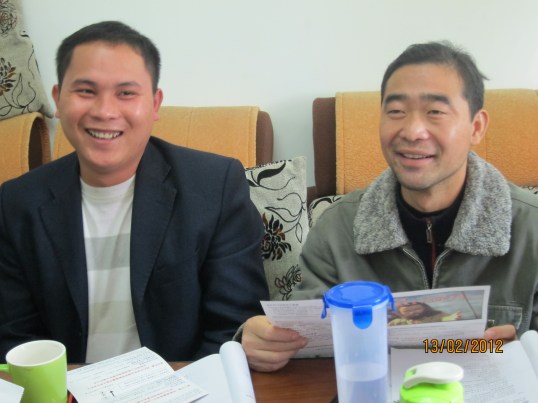
Yesterday I wrote about Dr. Li. Here he is, on the right

The Greatest Thing I’ve Ever Done

A few years ago I was producing a TV program in China called Moving Mountains.

It was a great job. We would travel all over the country shooting stories on people who were performing amazing acts of kindness and compassion. China is full of these stories.

Despite the perception (shared by the Chinese public) that most Chinese are primarily intent on getting rich and pursuing selfish goals, there are many stories of selfless sacrifice and astonishing generosity. We did one story on a man who adopted 200 children. Another followed a man in the mountains of central China as he carried an old, hand-cranked film projector and spools of film to the most remote villages imaginable. He just thought these people should have a chance to watch movies, too. So he devoted his life to bringing the movies to them. For free.

There were many other stories: some impressive in their scope, others very simple, like the one where three schoolboys vowed to carry a crippled schoolmate to school every day on their backs. At lunchtime they would carry him out to the playground and after school carry him home.

Then we found the story of Dr. Li. Dr. Li was a country doctor in a very poor part of southern China.

He was the only physician within a day’s travel, and people would come to his clinic with all kinds of medical problems–but seldom with enough money to pay for their treatment. Dr. Li never refused to treat anyone, and would give them medicine even if they couldn’t afford it. He paid for the medicine himself.

One day Dr. Li learned that he had kidney disease. The cost of the kidney medicine and dialysis were very expensive, and Dr. Li had no money, because he had used all of his own savings to help his patients. He borrowed from relatives, but eventually saw that he was only driving his family into debt, and decided that he would no longer treat his kidney disease. Dr. Li prepared himself for death.

It was at this time that our TV crew found him. We’d heard about the selfless, compassionate doctor in Guangxi province, so we’d arranged to come shoot his story. But we didn’t know that he was seriously ill. Dr. Li only told the crew about his situation reluctantly, as they were about to leave.

He had 2 weeks of medicine left. After that, he would purchase no more.

The crew called me and told me the situation. I told them to give whatever expense money they had left to Dr. Li, so at least he could buy a little more medicine. But we realized that what he needed was a kidney transplant, which cost about US$30,000 ($240,000 Hong Kong dollars). That was an insurmountable number. It might as well have been $30 million. But I felt clearly that we should do something to help Dr. Li. We took a collection among the staff here at the CBN Hong Kong office. That got us about HK$1,000. Then we told viewers of our Hong Kong TV program about Dr. Li’s situation, and mentioned that our staff had put together a little bit of money to help him. We told the audience that if they also wanted to help him, they could send money to our office in Hong Kong.

By the time donations reached HK$900,000, we had to tell people to stop giving.

The outpouring of support enabled Dr. Li to go to Beijing and have his surgery. The night before the operation he made a decision to become a Christian. You might be thinking: “sure, why not? A little insurance just in case something goes wrong.”

After he recovered, Dr. Li returned to his village and continued to help people just as he had always done. The big difference was, now he didn’t have to use his own money.

There was still about HK$400,000 (US$50,000) left. Some of that money was earmarked to pay for the anti-rejection medicine that Dr. Li would take for a long time, and to pay for his ongoing medical bills. But there was money left over to help cover the costs of poor villagers who continued to visit Dr. Li’s clinic. We asked the people who had donated to Dr. Li, and they all agreed that the extra money could be used this way.

He was able to buy some basic medical equipment for the first time, in order to serve the public better. He also initiated hygeine and preventive medicine programs in his region.

Dr. Li became famous in this part of China. A TV station from the provincial capital sent a crew to do a story about him and his service to the poor. They never mentioned CBN or our role in Dr. Li’s life. They also didn’t mention that he had begun holding Bible studies in his home, sharing his new faith with others and applying it in his own life. Over time many people in the region became Christians and became more involved in helping others. Churches from other provinces travel to his village to meet Dr. Li and his region has become very active in Christian service.

Last month the government asked Dr. Li if he would be willing to build a church in his village.

He said yes. The government is willing to tolerate this Christian stuff, but they want it all to be officially approved. The Chinese government is like that.

So why is this the greatest thing I’ve ever done? It’s not because I made something happen. It’s because when God spoke, I listened and trusted. I felt sure that we were called to help this anonymous country doctor, even though it would be impossible to raise enough money to assist him.

As Christians say, “God put it on my heart” to help Dr. Li. It seemed to be an impossible task, but I saw what God was able to do when we trust him and follow his guidance. I actually didn’t have to do much, except trust.

Some people will say that the greatest thing they’ve ever done is being a parent. That is an incomparable vocation. My wife and I try our best to raise our children well, and it is a joy to do so. But when it comes to a single action I have taken, a single thing that I have done, none compares to the simple decision to listen to God’s direction and follow it faithfully.

I have witnessed what happens. None of us at CBN did much in this situation, except to believe and obey.

That is the greatest thing you can do.

Post Navigation